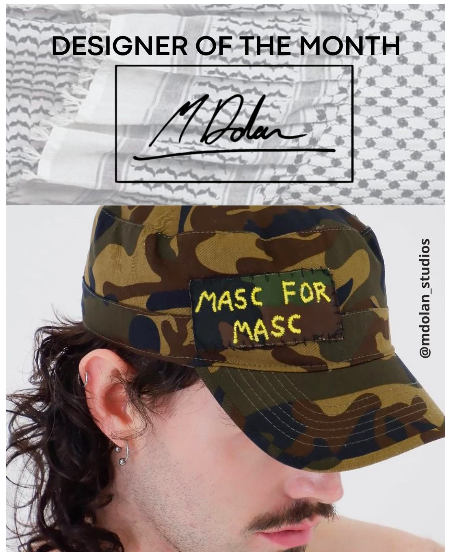
By Saoirse MacCarthy
Martin Dolan is an Irish designer now based in London, who blends his personal history, irony and activism into his collections. From his first collection, “Paint Splatter”, inspired by his father’s 1970 workwear, invoking nostalgia, to his provocative “Bring Back Masculine Men,” which challenges traditional masculinity through modular, gender-fluid designs. Martin challenges convention with wit and purpose. His Keffiyeh dress for Gaza raised funds for charity, showing fashion’s power for social impact.
Martin had an early start on his fashion career. As a child, he would sew clothes for dolls and sew Christmas stockings made of felt. He followed his instincts all the way to the Limerick School of Art and Design. Defying a tutor who was hesitant for him to take part in the fashion elective of his second semester. Martin used that as the push he needed to “jump in the deep end.” He launched himself into designing, creating multiple projects to prove that he could do it. By the end of the two-week elective, the tutor pulled him aside and said she had never seen him be so passionate. It became a no-brainer that Martin needed to pursue design, and later created MDolan Design.
Martin’s fashion career was a COVID baby; graduating during the pandemic meant that he left LSAD with no graduate collection, only mood boards. Martin took this setback as an opportunity to complete the graduate collection at his parents’ house during the lockdown. The challenges were not over yet; models and photographers weren’t a possibility, so Martin photographed the “Paint Splatter” collection in a marquee his family had in a shed, “And that whole photo shoot for that collection was all done in the back garden.”
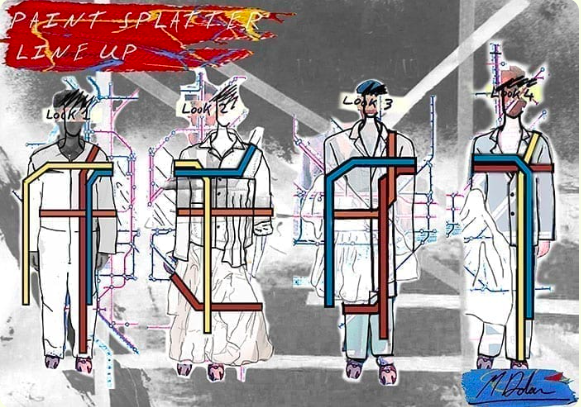
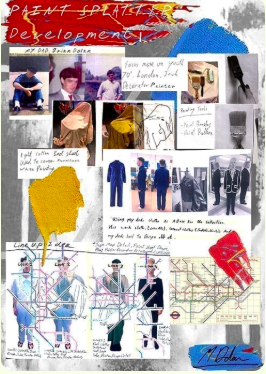
The collection was inspired by his father’s time in London in the 70s, working as a painter and decorator. Overalls created for the collection resembled the shape and cut of his father’s vintage workwear. “The whole collection is overlaid with the idea of a tube map and travelling back and forth across London,” painted designs over the pieces resemble an important element of London transport. “You have all these stripes of colours going across the collection. That’s all of the different tube lines.”
Martin’s father sadly passed away at the beginning of 2025.
Following in his father’s footsteps, Martin moved to London in October of 2021. Martin’s first solo collection was inspired by his time working at Weekday, a brand owned by H&M Group. At the time, Martin was also interning at a design studio. The sudden invasion of Ukraine by Russia flooded the news, causing the H&M Group to send out emails across all brands that any military or camo clothing had to be removed from the shop floor. Marti noted a historical element of men’s clothing, “ if you actually look at the history of men’s fashion, it’s always been coming from a military or utilitarian or very functional perspective.” Martin wanted to examine this military tradition in men’s clothing and challenge the “print, which has such a strong masculine history of, you know, war.”
A typical male stereotype in London is the ‘finance bro’ seen marching all around the city. Martin decided to deconstruct the classic men’s shirt that they are always spotted in, “and how that can transform and deform into other things.” Martin took a mannequin, a shirt, camo print fabric and got to work “playing with it on a mannequin to see how it would drape and fit. And I was like, how can I change the shirt, but have it still be a shirt at the same time? So make it modular and make it move.”
The module design element of the collection was innovative and economical: “to save money on resources and time, I only actually made one shirt.” The shirt was deconstructed into multiple looks. “In look two, it’s like a crop top with a draped back. In look three, it’s a skirt. It’s back to a shirt in look four, look five, it’s a dress.”
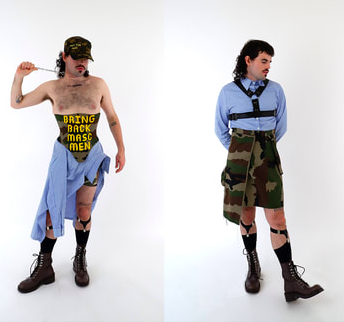
The challenge of traditional gender stereotypes was at the core of this collection. “Bring back Masculine Men” was a phrase seen across social media at the time in response to the war and Harry Styles photographed in Vogue wearing a dress, causing immense controversy online. Martin’s cheeky humour combined with camo prints and a men’s shirt, two “hyper masculine ideas of bringing back something that is toxic masculinity. And then making that into a corset was really tongue in cheek and really fun to do because I was like, this is, it’s like just layers of irony, which I love.”
Fashion cannot function by ignoring politics; fashion has always been influenced by the world around it. Making it natural for designers to utilise it to encourage social change. For Dublin Independent Fashion Week, in September, Martin recreated a dress he made for a friend out of Keffiyeh scarves to raise money for Palestine. His friend loved the dress Bella Hadid wore at the Cannes Film Festival 2024, designed by a New York-based brand created by Michael Sears and Hushidar Mortezaie. After completing the dress in black, Martin posted it online to receive a positive response. Martin created the dress again for auction; the dress sold for €176 and was given to charity. He worked with a visual artist from Gaza during DIFW to organise the donation to two charities, Gaza Go Bragh and Tea Collective. Martin has a strong belief in meaningful, action-based activism.
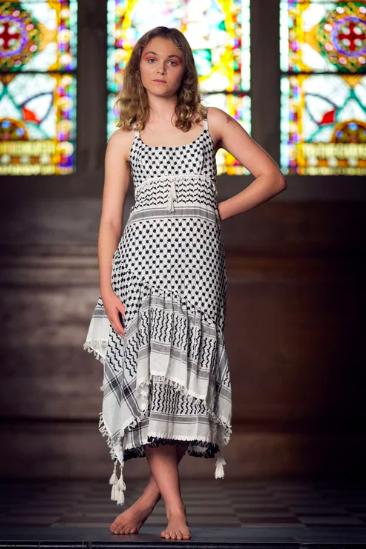
MDolan is shaped by Martin’s refusal to separate fashion from feeling, memory or politics. Whether reinventing his father’s workwear into painted nostalgia, dismantling the symbols of toxic masculinity with humour, or using a dress to raise money for Palestine, Martin designs with intention as much as imagination. In a fashion landscape increasingly searching for meaning, his work reminds us that style is at its strongest when it has something to say, and Martin Dolan is only getting started.
Martin Dolans designs can be found on his instagram, @mdolan_studio