By Saoirse MacCarthy
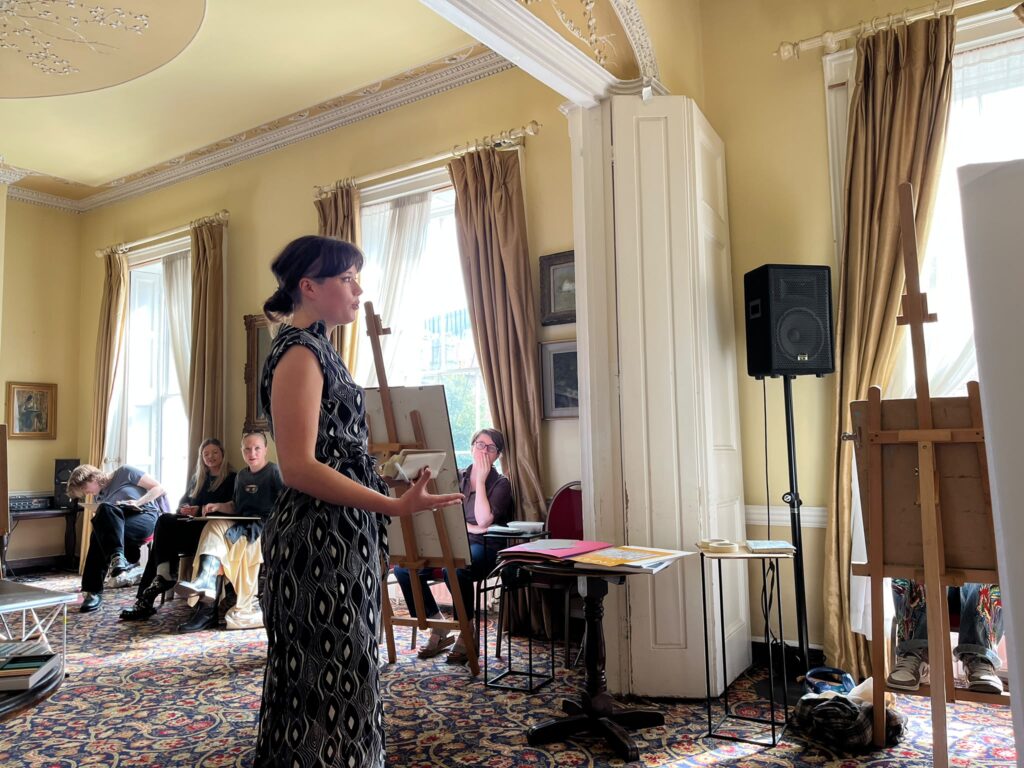
Exploring the human body may feel unnatural and uncomfortable for some people, but for Stephanie Johnson,
the human form is deeply compelling.
Before her departure to New Zealand for the World of Wearable Art (WOW), as a finalist designer, she wanted
to create a “beautiful moment” where people could draw her designs on live models. Stephanie’s creative
process involves investigating the human body from what is under the skin to the clothing we cover it with.
As part of Dublin Independent Fashion Week, Stephanie Johnson hosted a celebration of “the intersection of
Fashion and Life Drawing.” Where audiences could experience a live presentation of original garments by the
designer, “brought to life through a series of dynamic, timed poses.” Audiences were encouraged to draw the
designs while exploring the relationship between the fabric and the posed models.
The show was held in the historic United Arts Club building on Fitzwilliam Street Upper in Dublin 2. In the
upstairs space, paintings decorated the Georgian building. The space added to the creative atmosphere;
attendees settled into a large creative space filled with art supplies and easels. Before the event, Stephanie
said, “It feels like a really beautiful moment to have people come and draw my garments on live models.”
Stephanie hoped people would leave ‘Fabric and Figure’ with some creativity ignited and for it to be sparked
“in their own way.” Coming from an artistic family, her parents encouraged her to develop her style; she says, “I
was always making or doing, and if I wasn’t doing that, I’d be trying to understand how things worked and how
things were made.” This experimental mindset grew with her to the National College of Art and Design (NCAD),
where Stephanie graduated with a First-Class Honours Degree in Textile Art & Artefact. She initially went to
NCAD intending to study fashion but moved into textiles. Studying textiles fine art gave her more freedom to
experiment with materials, context, and garments.
During university, a life drawing class changed the trajectory of her design process. Wearing an unusual
costume that made Stephanie excited, a burlesque dancer was brought in for a life drawing class. She
described the experience as a moment to try to capture a glimpse of how clothing and the body interacted. She
said, “In the early stages, when I was designing things, I was drawing kind of fashion illustrations… but I found
that I needed to know the figure more to communicate these designs and to show what it was I wanted to
design and what I wanted to wear on the body.” In the 10 years that followed, Stephanie continued taking life
drawing classes, and it “became an obsession, which is still ongoing. I think it will always follow me through
life.” She says that this process is integral to her work; the drawings and her designs “speak to each other.”
After graduating, Stephanie did not have a completely predetermined career path. She gradually moved into
costume after being asked to create pieces for plays, films, and performances. Over time, repeated
commissions led to more work. Having the opportunity to create unique and one-off pieces allowed Stephanie
to explore her avant-garde style. She says when creating a garment, she must understand, “What’s underneath
the clothes? I need to know what’s underneath the clothes to then draw the clothes on top.” Stephanie’s
experimental approach has also taken her beyond Ireland. After entering WOW last year, a competition she had
admired for years, she became runner-up in the avant-garde category. Returning this year, she continues to
push the boundaries of wearable art.
As an artist, Stephanie felt the DIFW event was a “full-circle moment,” getting to share her excitement of
“being so inspired by the human body and creating garments for it” with her audience. Stephanie did not want
the event simply to be a fashion presentation. ‘Fabric & Figure’ was not about presenting fashion as something
distant or untouchable. It invited the audience to participate in the creative process. Instead, the garments
became something to observe, interpret, and reimagine.